
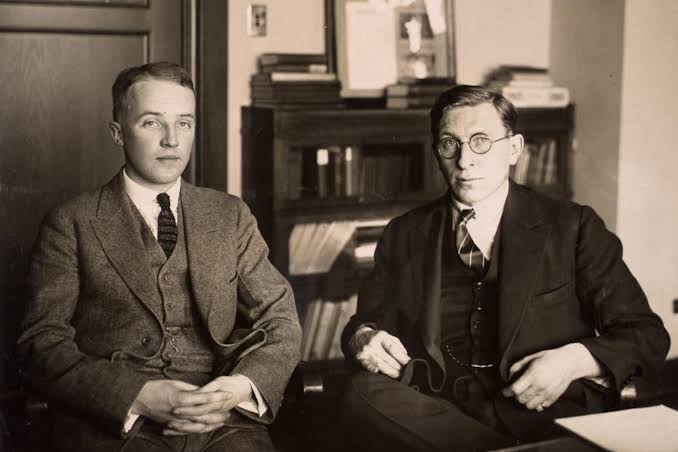
Historical profile. Charles Best was 22 years old when he began working in a University of Toronto laboratory in May 1921, helping a surgeon he barely knew investigate a mysterious substance inside the pancreas.
Within a year, the work he did with Frederick Banting had helped produce the first pancreatic extract administered to a person with diabetes. That initial treatment was not clinically successful. A more purified preparation, produced by biochemist James Collip, delivered the breakthrough that changed medicine.
Two years later, the Nobel Prize for the discovery of insulin went to Banting and the laboratory’s director, John Macleod. Best and Collip were left out.
The story of Charles Best and insulin is partly about how a young student helped transform an experimental extract into a medicine. It is also about who gets remembered for a scientific discovery, how that recognition is distributed, and what happens when the people involved begin rewriting their own histories.
A Summer Job With a Coin Toss in It
Best was born on February 27, 1899, in Pembroke, Maine, to Canadian parents. He attended school in Maine before completing his education in Toronto, according to historian Michael Bliss’s account in the Dictionary of Canadian Biography.
He entered the University of Toronto in 1916, moved into honours physiology and biochemistry, interrupted his studies for military service late in the First World War, and returned to complete his bachelor’s degree in the spring of 1921.
That summer, he was one of two student assistants working under John James Rickard Macleod, a respected physiologist who had agreed to let Frederick Banting investigate an idea about the pancreas.
Banting believed a substance produced by pancreatic cells could regulate blood sugar. Researchers already suspected such a substance existed, but nobody had yet developed a preparation that could reliably treat diabetes in people.
Macleod provided laboratory space, experimental animals, equipment, scientific guidance and student assistance. Best and his classmate Edward Clark Noble were assigned to help Banting.
How Best became the assistant is itself disputed.
The University of Toronto’s insulin centenary exhibit describes a coin toss between Best and Noble to decide who would work with Banting first. Best apparently won and later stayed through the summer, while Noble took a longer holiday.
Bliss records that Banting and Noble remembered the toss, while Best denied it.
It is a small historical disagreement, but an unusually revealing one. For someone who would spend much of his life defending his contribution to insulin, the possibility that his involvement began with chance was not an appealing detail.
Whatever happened with the coin, the laboratory work began on May 17, 1921.
Dogs, Pancreatic Extracts and a Hypothesis That Partly Failed
The first experiment involved removing a dog’s pancreas to produce diabetes.
Best’s primary responsibility was chemical measurement. He tested blood sugar, measured urinary glucose and helped determine whether injections of pancreatic extracts were changing the animals’ condition.
He also assisted Banting with surgery.
The early weeks were rough. According to the Toronto archival exhibit, Banting became angry with Best’s experimental methods, and the disagreement nearly turned physical. In early July, Banting realized that he had not properly tied off pancreatic ducts in some animals, forcing the team to repeat part of its work.
The experiments depended on animals that frequently died from diabetes, surgical complications or infection. Reliable measurements were difficult, the working conditions were uncomfortable, and progress was far less orderly than the discovery would later appear in textbooks.
On July 30, Banting and Best injected an extract from a treated pancreas into a diabetic terrier identified in the laboratory records as Dog 410.
The dog’s measured blood sugar appeared to fall from 0.20% to 0.12% within an hour. The researchers interpreted the result as encouraging, although the archival exhibit cautions that their equipment and testing intervals make the accuracy of those early measurements uncertain.
The terrier was found in a coma the next morning and died later that day.
Other experiments followed. Some animals showed temporary improvements in blood sugar or activity before dying. The results were promising enough to encourage the researchers, but nowhere near the reliable treatment that insulin would eventually become.
In mid-August, the team encountered another important result.
An extract prepared from fresh, whole pancreas appeared to work about as well as extract from a pancreas whose ducts had been tied off. That challenged Banting’s original theory that duct ligation was essential to isolating the internal secretion.
The researchers did not immediately recognize the significance of that result.
The first insulin experiments were messy, contested and full of dead ends, which is how many real discoveries look up close.
What Best contributed was the chemical evidence that allowed the team to judge whether an extract was working. A surgical hypothesis was not enough. The researchers needed measurements capable of distinguishing an actual reduction in blood sugar from a hopeful impression.
That work did not make Best the sole discoverer of insulin, but it made him a substantial participant in the experimental program.
The First Human Insulin Treatment Needed Better Chemistry
The work that followed required more than proving that pancreatic extracts could lower blood sugar in dogs.
To become a medicine, the extract had to be purified, made sufficiently potent and produced consistently enough to administer to human patients.
James Bertram Collip, an experienced biochemist, joined the Toronto team in December 1921. His expertise in purification would prove decisive.
On January 11, 1922, a 14-year-old boy named Leonard Thompson received an injection of pancreatic extract at Toronto General Hospital.
The preparation came from Banting and Best’s work.
It produced a modest reduction in blood sugar but little clinical benefit. The preparation also contained impurities and caused an abscess at the injection site, according to the University of Toronto’s archival records.
The breakthrough came on January 23, when Thompson received a more purified extract prepared by Collip.
This time his blood sugar fell dramatically and his clinical condition improved.
It was the successful treatment that established the therapeutic promise of insulin.
But the purification problem was not permanently solved. Collip subsequently struggled to reproduce the potency and consistency of his preparation, contributing to an acute shortage of usable insulin.
Best and Macleod worked on methods for producing potent extracts in small quantities, while the wider research team attempted to stabilize the process.
By the spring of 1922, a more dependable production method had emerged. Best became director of insulin production at Connaught Antitoxin Laboratories, and a partnership with Eli Lilly helped accelerate manufacturing.
Best was only 23.
This phase matters because discovering a biological effect and delivering a reliable medicine are different achievements.
Best participated in both. Collip’s purification work was essential, Macleod’s scientific leadership and organization were important, and Banting’s original experimental initiative helped bring the group together.
The insulin breakthrough became possible because those contributions were combined, even as the researchers increasingly disagreed over how the credit should be divided.
The Nobel Prize That Skipped Charles Best
In 1923, the Nobel Prize in Physiology or Medicine was awarded to Frederick Banting and John Macleod for the discovery of insulin.
Best and Collip were not named as laureates.
The Nobel committee recognized Banting’s initiating role and Macleod’s leadership in bringing the laboratory work to fruition. The decision remains one of the most debated examples of how scientific awards divide credit among collaborators.
Banting was furious that Macleod had been included and believed Best deserved recognition.
According to the Dictionary of Canadian Biography, Banting sent a telegram to Harvard, where Best was giving a lecture, declaring that he credited Best with an equal share in the discovery.
Banting divided his Nobel Prize money with Best. Macleod divided his own share with Collip.
The arrangement redistributed the money, but it could not change the names on the prize.
Best had reason to feel underrecognized. His name appeared on the scientific reports of the early experiments, and he had been involved in both the animal work and the subsequent production of insulin.
Yet Macleod was not merely a supervisor who happened to own the laboratory keys, and Collip was not a minor technician. Their work helped turn experimental findings into a treatment that could save human lives.
The question was never as simple as replacing one name on the Nobel citation with another.
The prize money could be shared. The Nobel recognition could not.
Best’s career after insulin also showed that he was much more than a young laboratory assistant.
He earned a master’s degree in 1923, completed his medical education in Toronto in 1925, and obtained a doctor of science degree from the University of London in 1928 after studying under the physiologist Henry Hallett Dale.
In 1929, he succeeded Macleod as professor and chair of physiology at the University of Toronto.
He investigated choline, the physiology of athletes and the purification of heparin, an anticoagulant whose earlier preparations had been difficult to use safely.
The heparin research became an important contribution to surgery and anticoagulant medicine.
Best and Banting did not collaborate again after the insulin project. Following Banting’s death in an aircraft crash in 1941, Best succeeded him as director of the university’s department of medical research.
The Charles H. Best Institute opened in Toronto in 1953, and Best became closely associated with diabetes research and patient organizations.
He died in Toronto on March 31, 1978.
When the Historical Record Got Rewritten
The most uncomfortable part of the Charles Best story is what happened to the history of insulin after the discovery itself.
Historian Michael Bliss spent years examining the archival documents, letters, laboratory notebooks and competing recollections of the people who worked on insulin.
In a 1993 article in the Journal of the History of Medicine and Allied Sciences, Bliss examined the development of what he described as the Banting and Best myth.
His later Dictionary of Canadian Biography entry argues that several accounts Best published after 1946 portrayed him as Banting’s equal partner while diminishing the contributions of Macleod and Collip.
Bliss concluded that important parts of those accounts were inconsistent with primary historical evidence, including some of Best’s own earlier writing.
He also interpreted private correspondence as evidence of a powerful desire for recognition that, in the historian’s judgment, brought Best dangerously close to deliberate misrepresentation of the historical record.
That is a serious criticism, and it should be understood as an archival historian’s assessment rather than a formal finding by a scientific or legal authority.
It also does not erase Best’s legitimate contribution.
He carried out biochemical measurements central to the 1921 experiments, contributed to published research and took responsibility for important manufacturing work when the treatment was still difficult to reproduce.
Both elements can be true: Best had grounds to object to being overlooked in accounts of the discovery, and his later efforts to correct that omission sometimes extended beyond what the surviving documents support.
The early insulin story had already been shaped by disputes among Banting, Macleod, Collip and their supporters. It was not simply Best who struggled over recognition.
Political influence, personal loyalties, institutional rivalries and the prestige of the Nobel Prize all helped determine which version of the discovery became familiar to the public.
Credit in science is not handed out once. It is argued over for decades, and the people involved are rarely neutral narrators.
Insulin’s history is especially vulnerable to that problem because the discovery was not a single event. It was a sequence of experiments, interpretations, purification advances, clinical decisions and manufacturing improvements.
Different people made indispensable contributions at different stages.
Readers interested in what happened to insulin after those early experiments can also explore Grey Pepper’s profiles of Rosalyn Yalow and the development of radioimmunoassay and Dorothy Hodgkin’s work on insulin’s molecular structure.
Both stories show how scientific breakthroughs often take decades of work by people who are absent from the simplest version of the history.
Why Charles Best Still Matters
Insulin became one of the foundational medicines of modern endocrinology and an early demonstration that a peptide hormone could be produced and administered as a life-saving treatment.
Nearly every therapeutic peptide developed since has faced some version of the practical challenges confronting the Toronto researchers: how to make a fragile biological molecule sufficiently pure, potent, stable and consistent to use in patients.
Those challenges now appear in a very different technological setting, from engineered insulin analogues to long-acting GLP-1 medicines.
Best’s work at Connaught on producing usable insulin was an early contribution to solving the manufacturing side of that problem.
The documents also demonstrate how easily a famous scientific discovery becomes simplified into a story about one or two extraordinary individuals.
The summer of 1921 involved a surgeon, a student, a physiology professor and experimental animals. The successful treatment in January 1922 depended on additional biochemical expertise, clinical care and the ability to improve an unreliable preparation.
The commercial breakthrough depended on still more people, institutions and industrial processes.
None of that makes Best unimportant. It makes the discovery larger than any one participant.
The coin toss may or may not have happened. The blood-sugar tests did.
Best’s lasting contribution deserves recognition without requiring a diminished account of Macleod, Collip or the other scientists involved.
The history is also a reminder that being excluded from an award and being excluded from a discovery are different things.
Charles Best helped make insulin possible, was not named on its Nobel Prize, and spent much of his later life negotiating what that distinction meant.
A century later, his most compelling legacy is not that he deserved every honor he sought. It is that the measurements he made as a young student helped turn a difficult experiment into one of medicine’s greatest collaborative achievements.
Sources and Further Reading
- Bliss M. Best, Charles Herbert. Dictionary of Canadian Biography, Volume XX. University of Toronto and Université Laval, 2018. Biographical account based on archival research.
- University of Toronto, Thomas Fisher Rare Book Library. The Discovery of Insulin: III. The Summer of 1921. Historical exhibition covering the experiments, coin-toss account and early laboratory results.
- University of Toronto Libraries. Leonard Thompson. Archival account of the January 11 and January 23, 1922, insulin treatments.
- University of Toronto Libraries. Biography of Charles Herbert Best (1899–1978). The Discovery and Early Development of Insulin collection.
- The Nobel Prize. The Nobel Prize in Physiology or Medicine 1923. Official award record for Frederick G. Banting and John J. R. Macleod.
- Bliss M. Rewriting Medical History: Charles Best and the Banting and Best Myth. Journal of the History of Medicine and Allied Sciences. 1993;48(3):253–274. DOI: 10.1093/jhmas/48.3.253.
- University of Toronto, Thomas Fisher Rare Book Library. The Discovery of Insulin: VIII. The Struggle for Glory. Historical account of the disputes over scientific recognition and the Nobel Prize.
- University of Toronto Libraries. Archival photograph, circa 1924–1925. Thomas Fisher Rare Book Library, Banting Papers, P10103. Image provenance and collection information.