
Most attempts to build an underwater glue start at the seashore. Mussels and barnacles cling to wet rocks, and chemists have spent decades copying the proteins that let them do it. A Yale-led team went somewhere less charming for inspiration: the slime of Vibrio cholerae, the bacterium that causes cholera. In a study published online November 4 in Science Advances, researchers showed that a short peptide taken from one of the bacterium’s biofilm proteins can stick to wet glass, silica and plastic, and hold surfaces together under wet conditions.
The results are materials science, not medicine. Researchers tested synthetic peptides, material surfaces and bacterial biofilms. They did not establish whether the peptide would be safe or effective in people. But the finding offers an unexpected alternative to the marine animals that have dominated underwater adhesive research.
A Pathogen’s Grip, Repurposed
Bacteria rarely live alone. Many build biofilms, communities wrapped in a self-made matrix that anchors them to surfaces, from ship hulls to medical tubing. In V. cholerae, a matrix protein called Bap1 helps those communities hold onto non-living surfaces.
Earlier work by the same researchers had traced much of that grip to a 57-amino-acid loop tucked inside one of Bap1’s folded domains. The loop contains four repeating segments organized around an aromatic-rich central stretch with the sequence WFFG.
For the new study, first author Xin Huang, senior author Jing Yan and collaborators at institutions including Yale, Wesleyan University, the University of Illinois Chicago, the National Institute of Standards and Technology and the University of California, Merced, investigated that sequence as a possible standalone adhesive.
The team synthesized the 57-amino-acid segment chemically and examined how it attached to different surfaces. They also changed or shortened parts of the sequence to find out which features contributed to adhesion.
The question was simple: once the adhesive segment is taken out of the bacterium, does it still stick?
Chemists usually copy mussels to glue things under water. This team copied a peptide from cholera’s slime.
How the Underwater Glue Performed
It does stick. Fluorescently labeled peptide coated silica beads and polystyrene beads with different surface chemistries, with adsorption signals approaching saturation at roughly 0.5 to 1 micromolar. Quartz crystal microbalance measurements also showed that the peptide could form a persistent surface layer.
The researchers then used atomic force microscopy, which can measure extremely small forces. In one experiment, a silica bead coated with the peptide was attached to a tiny cantilever and brought into contact with a mica surface under water. Pulling the bead away revealed a pull-off force of 11.5 nanonewtons for the full-length peptide.
Shortened or modified versions performed much worse. A 10-amino-acid core fragment and a variant in which the WFFG stretch was replaced with another sequence showed pull-off forces more than three times lower than the full peptide.
That result suggests the adhesion depends on the complete 57-amino-acid segment working together, rather than one short sticky patch. The relative contribution of each section also depended on the material being tested.
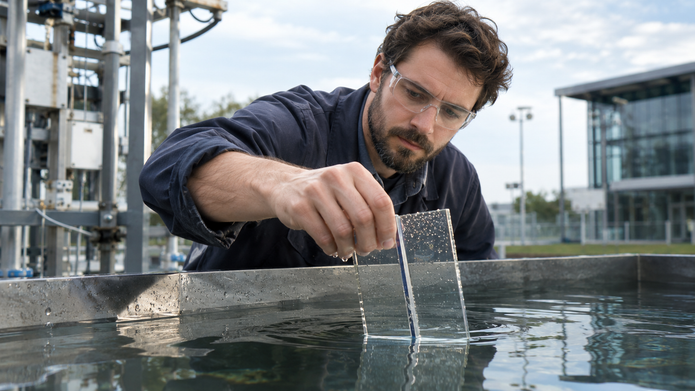
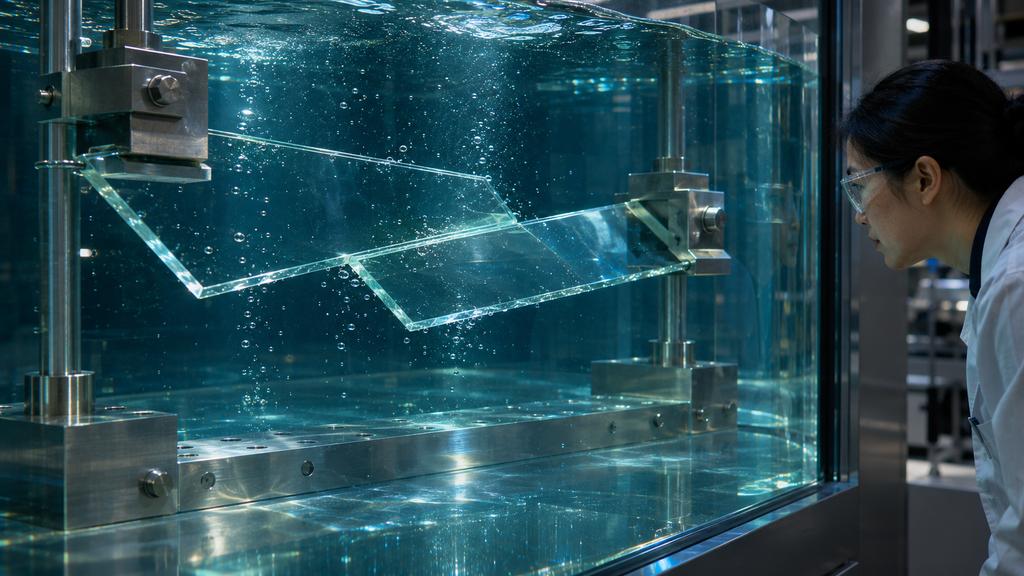
The more practical experiment involved two overlapping glass slides with a concentrated peptide solution between them. Using an 8 mg/mL solution across a one-square-centimeter contact area, the team reported wet adhesion exceeding 80 kilopascals under specified preparation conditions.
The method needs a distinction. Although the researchers describe the experiment as a lap-shear test, their methods specify measuring the force needed to separate the bonded surfaces in a pull-off direction, rather than measuring resistance to one slide moving sideways against the other.
The measurements were considerably stronger than those obtained with bovine serum albumin, a control protein. The peptide also produced higher adhesion values in 400 millimolar sodium chloride solution than in deionized water. The authors suggest that dissolved salt helps screen electrical repulsion between charged groups, allowing peptide molecules to associate more strongly.
The preparation conditions differed between the two water types, however, including the temperature used during the brief equilibration step. That limits how confidently the difference can be attributed to salt alone.
Why Underwater Adhesive Research Cares About Chemistry
Mussel-inspired glues rely heavily on a modified amino acid called DOPA, which mussels produce through chemical modification of their proteins. DOPA creates strong interactions with surfaces, but it is chemically reactive and sensitive to environmental conditions. Reproducing that chemistry can also add complexity to synthetic adhesives.
The cholera-derived peptide contains no DOPA. Its adhesive behavior instead comes from a combination of charged amino acids, aromatic residues and interactions between the peptide and the surface.
The researchers argue that avoiding DOPA could simplify production and make the material easier to engineer. They reported wet-glass adhesion comparable with certain mussel-inspired molecules examined under similar laboratory concentrations. They did not demonstrate superiority over commercial adhesives.
No DOPA modification is needed. The attraction is a potentially simpler molecular starting point for wet adhesives.
The peptide also showed a second talent. When mixed with 200-nanometer polystyrene beads, used as a model for tiny plastic contaminants, it pulled the particles into clumps. The process is called flocculation.
At peptide concentrations above roughly one micromolar, most of the model particles became associated with aggregates. The team suggests that this behavior could eventually be useful for water treatment, where gathering small suspended particles into larger clusters can make them easier to remove.
That is a possible application, not an established water-purification technology. The tests used controlled suspensions of laboratory particles rather than wastewater containing a mixture of pollutants, microorganisms and dissolved chemicals.
The investigators also explored whether bacteria could produce the peptide more cheaply than conventional chemical synthesis. They expressed it in Escherichia coli and recovered material that retained particle-aggregating activity. But purification proved difficult, and the bacterial preparation performed less efficiently than the chemically synthesized version in the flocculation experiments.
That difference matters for scale-up. A molecule that performs well when synthesized and purified in small quantities may be much harder to manufacture economically at industrial volumes.
What the Study Does Not Show
This is early materials research. The adhesive experiments focused on surfaces including glass, silica, mica and polystyrene. The investigators also studied living bacterial biofilms to understand how changes to the Bap1 sequence affected the ability of the bacteria to remain attached to glass.
Those experiments were not tests of a treatment in mammals. The study did not establish that the isolated peptide is safe for medical use, does not harm human cells or can function as a surgical sealant.
The authors discuss potential biomedical uses and note related work incorporating the sequence into chitosan-based materials designed to adhere to mucous membranes. That work should not be confused with a demonstration of clinical safety or effectiveness in this study.
The engineering questions also remain open. Adding positive charge might strengthen attraction to certain surfaces while changing how peptide molecules bind to one another. Some edited versions behaved differently depending on the material being tested. The interaction of the peptide with a surface is therefore not a simple property that can be transferred unchanged from glass to metal, skin or other materials.
Environmental conditions need further investigation. The mechanical tests used controlled solution chemistry and specific preparation procedures, and some structural spectroscopy measurements were performed on dried films rather than fully wet interfaces. Performance after prolonged immersion, repeated stress or exposure to complex real-world environments has not been established.
There is also a manufacturing problem. Although the researchers produced functional peptide material using E. coli, the resulting preparation contained impurities and its particle-aggregation performance was weaker than that of the chemically synthesized peptide. Large-scale purification, product consistency and cost remain unresolved.
The work received support from agencies including DARPA, the National Institutes of Health, the Department of Energy and the National Science Foundation. The researchers disclosed a pending patent application covering aspects of Bap1-derived adhesion technology, with Jing Yan and Rich Olson named as inventors.
None of these limitations makes the experimental result insignificant. They define the difference between finding a promising adhesive sequence and having a usable material.
Learning From a Microbe’s Design
The study belongs to a growing movement in peptide science: treating nature’s sequences as engineering blueprints. Grey Pepper has previously covered self-healing peptide glass and peptide hydrogels that change their behavior with wound chemistry.
Bacteria have spent a very long time evolving molecular structures that cling, bind and assemble under wet, salty and chemically complicated conditions. Those are precisely the environments in which human-made adhesives often struggle.
The authors propose bacterial biofilms as an alternative source of design inspiration to mussels and barnacles. Rather than copying the chemistry of a marine animal, researchers might borrow the surface-binding strategies of microorganisms and then alter the sequence for a particular application.
The same molecular segment that helps a cholera biofilm grip a surface can also hold wet glass together in a laboratory experiment.
There is an irony in borrowing from a pathogen responsible for devastating disease. But a synthetic peptide with a sequence derived from a bacterium is not the living bacterium, and its purpose here is mechanical rather than infectious. That distinction does not eliminate the need for safety testing if a medical application is ever pursued.
Whether this sequence becomes part of a marine coating, a filtration process, a medical material or nowhere beyond the journal page depends on experiments that have not yet been done.
For now, the conclusion is narrower and more interesting: one of biology’s most unwelcome guests turns out to possess a molecular component with a remarkably useful grip.
Sources
- Science Advances — Huang X, Liszczyk ED, Prasad R, et al. “A biofilm-derived peptide as an underwater adhesive.” Volume 12, Issue 45, eaei1795. Published online November 4, 2026. https://doi.org/10.1126/sciadv.aei1795.
- PubMed — Published journal article and author information, PMID 42981400. https://pubmed.ncbi.nlm.nih.gov/42981400/.
- PubMed Central — Published article record, PMC13733808. https://pmc.ncbi.nlm.nih.gov/articles/PMC13733808/.
- bioRxiv / PubMed Central — Huang et al., detailed full-text preprint and experimental methods, August 6, 2026. https://pmc.ncbi.nlm.nih.gov/articles/PMC13484692/. Preprint methods consulted for measurement conditions and production limitations.