
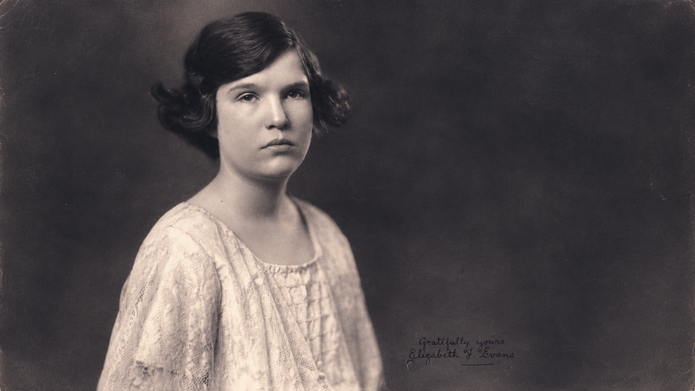
Historical profile. When Elizabeth Hughes arrived in Toronto in August 1922, she weighed 45 pounds. She was 14, days short of her fifteenth birthday, the daughter of the sitting U.S. Secretary of State, and she had spent roughly three years on a near-starvation diet that was then the only way doctors knew to prolong the life of a child with severe diabetes.
Frederick Banting’s examination notes described her as extremely emaciated, with wasted muscles and almost no remaining body fat. She was scarcely able to walk.
Within days of arriving in Toronto, she began receiving insulin, a peptide hormone that had first been administered to a human patient only seven months earlier.
The treatment changed the course of her life. By the end of November, she weighed 79 pounds. She returned to school, went to college, married, raised three children and lived for another 58 years.
Then she spent much of that life making sure almost nobody outside her family and medical circle knew she had diabetes.
The story of Elizabeth Hughes is preserved in the University of Toronto’s insulin archives, where her letters, photographs and treatment records provide an unusually personal account of what happened when a disease that had meant almost certain death became treatable.
A Diagnosis That Used to Mean Months
Elizabeth Evans Hughes was born on August 19, 1907, in Albany, New York, where her father, Charles Evans Hughes, was serving as governor. He later became U.S. Secretary of State from 1921 to 1925 and Chief Justice of the United States from 1930 to 1941.
Elizabeth developed severe diabetes at age 11. The University of Toronto archives date her diagnosis to 1919, although some later accounts give 1918.
Before insulin, childhood diabetes was usually fatal within months or a few years. Doctors could manage symptoms temporarily, but they had no effective way to replace the hormone the patient’s body could no longer produce.
The best treatment available to Elizabeth’s family came from Dr. Frederick Madison Allen, whose Physiatric Institute in Morristown, New Jersey, specialized in severe dietary restriction for diabetes.
The logic was brutal but understandable for its time. Without insulin, the body could not properly regulate glucose. Severely restricting food sometimes prolonged survival by reducing the metabolic demands placed on a failing system.
It also slowly starved patients.
Elizabeth lived at home under Allen’s supervision with a private nurse, Blanche Burgess, carefully recording her food intake and following restrictions that sometimes allowed her only a few hundred calories per day.
She endured the regimen for about three years. Her condition nevertheless deteriorated.
In January 1922, her family sent her to Bermuda with Burgess, hoping that a warmer climate might help restore some of her strength. By June, she had returned to Washington in an extremely weakened condition.
By August, at approximately five feet tall, Elizabeth weighed only 45 pounds.
The most advanced diabetes treatment available to Elizabeth in 1919 could prolong her life only by restricting the food she needed to survive.
August 1922: Getting Into Toronto
News of insulin spread rapidly in 1922, but supply was scarce. The University of Toronto team was still struggling to produce reliable quantities of the experimental extract, and requests arrived from desperate families across North America.
Elizabeth’s mother, Antoinette Hughes, wrote to Frederick Banting on July 3, describing her daughter’s condition and asking whether he could treat her.
Banting initially refused because there was not enough insulin available. By August, the supply situation had improved enough for him to agree.
The Hughes family had resources and political connections that most patients could not call upon. That does not establish that anything improper occurred, but it illustrates how unequal access could be when a lifesaving treatment was still scarce.
Elizabeth arrived in Toronto with her mother and nurse on August 15. Banting examined her the following day, three days before her fifteenth birthday.
His notes recorded her weight at 45 pounds, with dry skin, brittle hair, profound muscle wasting and weakness so severe that walking was difficult.
Her first insulin injection was administered on August 16 or 17, according to the University of Toronto’s surviving treatment records.
The change was extraordinary.
Within two weeks, her diet had been expanded to approximately 2,200 to 2,400 calories a day. Foods that had effectively been forbidden during years of dietary restriction became part of her meals again.
Her records show that average daily calorie intake rose from 1,125 to 2,512 during her Toronto treatment, while her weight increased from 45 to 79 pounds by November 30.
In about three and a half months, she gained 34 pounds.
Her correspondence captured the psychological change as vividly as the medical measurements. She wrote enthusiastically to her mother about eating, gaining strength and returning to activities that had once seemed impossible.
Her improvement was not merely a better number on a chart. She could participate in everyday life again.
Elizabeth left Toronto on November 30, 1922, Thanksgiving Day. The girl who had arrived barely able to walk was now steadily rebuilding her strength.
A Life Lived in Plain Sight
Elizabeth’s recovery continued after she returned to Washington.
In a letter to Banting dated January 1, 1923, she reported weighing 84¾ pounds and riding horseback three times a week. She was also considering swimming and was preparing to resume courses at school.
Five months earlier, walking had been a struggle. Now she was riding horses.
Elizabeth returned to school in 1923 and graduated from Barnard College in 1929. In 1930, she married William T. Gossett, a lawyer at her father’s former firm who later became general counsel of the Ford Motor Company and president of the American Bar Association.
They had three children and settled in Michigan.
Elizabeth built a substantial public career. She became a trustee of Barnard College and a founding trustee of Oakland University. She also participated in civic and educational organizations in the Detroit area.
In 1972, she founded the Supreme Court Historical Society and served as its president until 1979.
Her public achievements were not accompanied by a public discussion of the illness that had nearly killed her.
She continued using insulin throughout her life. Some historical accounts estimate that she received approximately 42,000 injections over nearly six decades, although that is a retrospective estimate rather than a verified injection-by-injection count.
What had begun as an experimental treatment in Toronto became part of her ordinary daily routine.
That transformation also tells a larger scientific story. The work required to turn insulin from a scarce animal-pancreas extract into a widely available medicine continued long after 1922.
Later developments included producing human insulin through recombinant DNA technology, a scientific transition Grey Pepper examined in its profile of Axel Ullrich and the history of recombinant human insulin.
Subsequent researchers went further, modifying insulin’s amino-acid structure to change how quickly it acts and how long its effects last.
That tradition of peptide engineering eventually extended into other metabolic hormones. Grey Pepper has covered the development of engineered insulin analogs and newer peptide therapies in its profile of Richard DiMarchi.
But for Elizabeth, the scientific revolution was already personal in 1922. A hormone that her body could no longer produce had become something physicians could administer.
Insulin gave Elizabeth Hughes the opportunity to live a long adult life. She chose not to make diabetes the defining public fact about it.
The Secret, and What It Cost the Historical Record
One of the most striking details in the University of Toronto’s account is how carefully Elizabeth guarded her medical history.
The archives describe her belief that few of her friends or associates knew she had diabetes. Diabetes UK also records that she avoided discussing the condition publicly and initially agreed to appear in an insulin history only under an alias.
Biographical accounts report that she destroyed documents referring to her illness and had references to diabetes removed from some of her father’s papers.
It would be easy to interpret that secrecy as embarrassment or shame. The surviving evidence, however, does not establish a single reason for her choices.
She lived in an era when chronic illness could carry substantial social stigma, particularly for someone from a prominent family. But the historical record does not justify turning a possible explanation into a statement about her private thoughts.
What can be said is that Elizabeth placed a high value on privacy.
That choice created an unusual problem for historians. One of the earliest and most closely documented insulin patients did not spend her later life publicly celebrating her medical history.
Yet the record was never completely lost.
The Thomas Fisher Rare Book Library at the University of Toronto preserves the Elizabeth Hughes Papers, a collection containing 53 letters, 22 photographs and a commemorative medal.
Eighteen of those letters describe her experiences in Toronto between August and November 1922. Her original correspondence remained with the family after her death and was donated to the library in 1996.
The archive also preserves material relating to Banting’s examinations, treatment charts and subsequent correspondence with Elizabeth.
Those documents show a patient who remained intensely attentive to her medical condition even as she kept it largely separate from her public identity.
They also complicate the idea that her story disappeared entirely.
Elizabeth was interviewed by historian Michael Bliss while he was researching The Discovery of Insulin, published in 1982. She therefore did not refuse every effort to preserve or understand what had happened to her.
Instead, the available evidence suggests a distinction between choosing privacy in everyday life and allowing selected parts of a medical history to survive for researchers.
Her reasons for drawing that boundary remain her own.
Why Elizabeth Hughes Still Matters
Elizabeth Hughes died in 1981 at age 73, having lived for nearly 59 calendar years after beginning insulin treatment in Toronto.
She had seen insulin develop from an experimental extract available to a small number of desperate patients into an established treatment used around the world.
The history of insulin is usually told through the scientists who discovered, purified, sequenced and manufactured it.
That is understandable. The scientific achievement was enormous.
But Elizabeth’s experience shows what the discovery meant inside a single human life.
Before Toronto, her treatment meant increasingly severe food restriction and a body that was gradually wasting away. After Toronto, it meant injections, careful management and the possibility of education, marriage, children, travel and decades of work.
Her case should not be mistaken for the experience of every early insulin patient.
She came from a wealthy and politically prominent family, had the benefit of private nursing care and received close attention from one of the scientists at the center of the discovery.
Many other patients in 1922 struggled to obtain insulin at all, while doctors were still learning how to administer it safely and consistently.
Elizabeth’s outcome was extraordinary, but it was not available to everyone at the same time.
In 1995, Eli Lilly commissioned Welsh Insulin Medals honoring people who had lived with diabetes for at least 50 years. The medals carried Elizabeth Evans Hughes’s name, recognizing her place among the earliest children treated with insulin and her family’s Welsh heritage.
It was an unusual tribute to someone who had preferred to keep her diabetes largely outside the public record.
But the records that survived offer something more valuable than a simple legend of medical rescue.
They show the before and after of one of medicine’s most important discoveries: a fourteen-year-old weighing 45 pounds in August 1922, a girl weighing 79 pounds when she left Toronto in November, and a young woman reporting in January that she was riding horseback again.
Elizabeth Hughes lived long enough to make diabetes a private part of an otherwise public life. That possibility was precisely what insulin had given her.
Sources and Further Reading
- University of Toronto Libraries, Thomas Fisher Rare Book Library. Elizabeth Evans Hughes. Insulin 100 archival exhibition, including Banting’s treatment notes, correspondence and historical timeline.
- University of Toronto Libraries. Hughes (Elizabeth) Papers, Manuscript Collection 334. Collection description, correspondence, photographs and biographical record.
- University of Toronto Libraries. The Discovery of Insulin at the University of Toronto: VII. Resurrections in Toronto. Historical background on insulin shortages and early patients.
- Rutty CJ. Elizabeth Hughes: Letters from Toronto. Insulin 100 historical research project, Defining Moments Canada.
- Diabetes UK. Elizabeth Evans Hughes and the Welsh Connection to Insulin. November 8, 2021.
- University of Toronto Libraries. Photograph of Elizabeth Hughes, circa 1923. Archival photograph record, Harris & Ewing.


