
For much of the past year, the Ozempic blindness lawsuit has been an argument about a warning that did not appear in U.S. prescribing information.
Plaintiffs allege that Novo Nordisk and Eli Lilly failed to adequately warn doctors and patients about a possible association between GLP-1 medications and non-arteritic anterior ischemic optic neuropathy, or NAION, a rare eye condition that can cause sudden and permanent vision loss.
The manufacturers contest the claims.
On November 9, 2026, the U.S. Food and Drug Administration changed the regulatory landscape. It announced that application holders for GLP-1 receptor agonist medications must add information about a potential increased risk of NAION to the Warnings and Precautions section of their labeling.
The timing matters. Federal litigation over the same alleged injury has been organized around two questions: whether the medications can cause NAION and whether the manufacturers’ existing warnings were legally adequate.
The new FDA action speaks to both questions without conclusively resolving either.
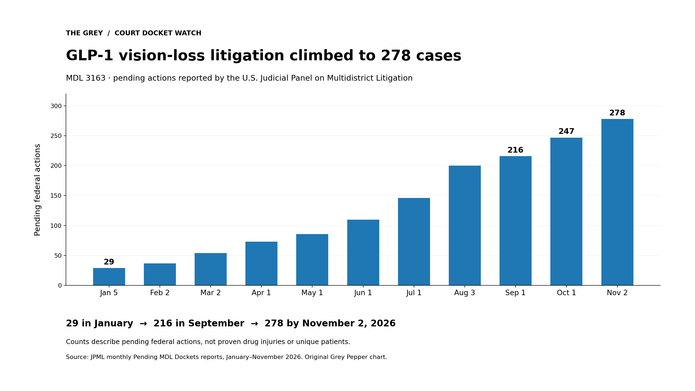
The litigation is also larger than previously reported. The Judicial Panel on Multidistrict Litigation listed 278 pending federal actions as of November 2, up from 216 on September 1.
This is a follow-up to Grey Pepper’s earlier report on the GLP-1 vision-loss docket. The regulatory action is new. The questions now facing the court are not.
Where the Ozempic Blindness Lawsuit Stands
The federal cases are consolidated as MDL 3163, formally titled In re Glucagon-Like Peptide-1 Receptor Agonists Non-Arteritic Anterior Ischemic Optic Neuropathy Products Liability Litigation.
The proceedings are before U.S. District Judge Karen Spencer Marston in the Eastern District of Pennsylvania.
The Judicial Panel on Multidistrict Litigation centralized the cases in December 2025. The transfer order involved 21 actions, with additional related cases identified at the time.
By January 5, 2026, the panel’s monthly report recorded 29 pending actions. That number rose to 146 by July 1, 200 by August 3, 216 by September 1 and 247 by October 1.
On November 2, the official count reached 278.
These figures describe pending federal actions, not proven injuries or findings of liability. They also do not include separately coordinated state-court proceedings.
New Jersey has established its own multicounty litigation structure for GLP-1-related NAION claims, assigning those proceedings to Bergen County. The state litigation is separate from MDL 3163.
Judge Marston also oversees MDL 3094, a different federal proceeding involving allegations of gastrointestinal injuries associated with GLP-1 medications.
In the vision-loss litigation, the court has chosen to address broad scientific and legal questions before selecting individual cases for possible trials.
Case Management Order No. 12, issued July 2, 2026, approved early discovery and motion practice on two cross-cutting issues: general causation and federal preemption together with warning adequacy.
General causation asks whether a medication is capable of causing the alleged injury. Warning adequacy concerns whether the relevant risk information was properly communicated. Preemption addresses whether federal drug regulation may limit or bar particular state-law warning claims.
Those issues can affect many plaintiffs at once, which explains why the court has prioritized them.
No bellwether trial schedule has been established through the reviewed case-management orders. Such trials, if selected later, would test individual claims after the preliminary scientific and legal disputes have progressed.
The court put causation and warnings near the front of the litigation. The FDA has now issued a safety communication directly relevant to both.
What the FDA Said, and What It Did Not
The FDA’s November 9 Drug Safety Communication uses careful language.
The agency concluded that GLP-1 receptor agonists may be associated with an increased risk of NAION, a condition caused by reduced blood flow to the front portion of the optic nerve.
It did not conclude that every GLP-1 medication causes NAION, that every reported event was drug-induced or that any individual lawsuit has established causation.
The distinction is important because the agency reviewed several forms of evidence that did not all produce identical results.
One analysis pooled data from 126 randomized controlled clinical trials involving 134,253 patients and approximately 288,879 person-years of exposure.
Investigators identified 15 probable NAION events: ten among patients receiving GLP-1 medications and five among patients receiving comparators.
That corresponded to incidence rates of 6.4 versus 3.8 events per 100,000 person-years.
Those are small absolute numbers, although the difference was sufficient to contribute to the agency’s broader safety assessment.
The FDA also analyzed real-world medical and insurance data through its Sentinel system.
Among adults with type 2 diabetes, GLP-1 treatment was associated with a statistically significant increase in NAION risk compared with DPP-4 inhibitors, with a hazard ratio of 1.43 and a 95% confidence interval from 1.02 to 2.01.
The comparison against SGLT-2 inhibitors was different. Its hazard ratio was 1.19, with a confidence interval from 0.91 to 1.54, and was not statistically significant.
These findings are not interchangeable. The reference treatment, underlying patient characteristics and study design can influence an observed association.
The FDA also reviewed published observational studies, adverse-event reports and animal research.
It noted that rigorous observational studies generally identified increased NAION risk among patients starting GLP-1 treatment compared with certain alternative diabetes medications.
But spontaneous safety reports were difficult to interpret because people receiving GLP-1 medications often have underlying conditions that are themselves associated with NAION.
Those conditions include diabetes, hypertension, sleep apnea and kidney disease.
The agency’s review of available animal data did not identify a biological mechanism explaining how GLP-1 treatment could increase NAION risk.
Based on the totality of evidence, the FDA required updated safety labeling across the GLP-1 receptor agonist class.
That includes products containing semaglutide and tirzepatide, among others. It is a requirement directed at application holders, rather than proof that every individual product label had already been updated on November 9.
The decision creates a new regulatory fact. It does not establish the cause of an individual patient’s blindness.
Causation Is a Scientific Question With Legal Stakes
General causation is one of the first major issues the federal court plans to examine.
In product-liability litigation, experts may be asked to evaluate whether a drug is capable of causing the type of injury alleged by plaintiffs.
That question is different from specific causation, which asks whether the drug caused the injury suffered by a particular person.
The FDA’s new assessment is highly relevant to the scientific discussion. It brings together randomized trials, real-world data and postmarketing safety evidence, and it concludes that the potential risk warrants labeling changes.
But a regulatory warning is not automatically a judicial finding of general causation.
Drug regulators can require warnings based on safety signals and evidence of potential harm. Courts evaluating expert opinions must apply the evidentiary rules governing scientific testimony and the legal requirements of the claims before them.
Whether the FDA communication itself is admitted for a particular purpose, and how much weight the court gives it, will depend on those rules and the arguments made by the parties.
Plaintiffs may point to the agency’s class-wide labeling requirement, the pooled trial findings and its discussion of observational studies supporting an increased risk.
Defendants may emphasize the small number of trial events, the inconsistent comparator findings, the absence of an identified mechanism and the overlap between NAION risk factors and the medical conditions treated with GLP-1 drugs.
European regulators reached a related but not identical conclusion.
In June 2025, the European Medicines Agency’s safety committee concluded that NAION should be considered a very rare side effect of semaglutide medicines, including Ozempic, Rybelsus and Wegovy.
Its assessment found sufficient evidence to establish a causal relationship for semaglutide, with a frequency classification of up to one case per 10,000 treated people.
The November 2026 FDA decision covers the broader GLP-1 class and describes a potential increased risk rather than making the same categorical statement for every product.
That difference in scope and regulatory interpretation will matter when experts explain the evidence.
Europe classified NAION as a very rare semaglutide side effect. The FDA identified a potential risk across the GLP-1 class. Neither decision resolves an individual lawsuit.
The Warning-Adequacy Fight Just Changed Shape
A failure-to-warn claim is not simply an argument that a medicine has a risk.
It asks whether the manufacturer had a legal duty to disclose relevant information, whether the warning provided was adequate and whether any alleged failure contributed to the plaintiff’s injury.
The November 9 FDA communication adds a new date to that inquiry.
Before the announcement, the contested U.S. labeling generally did not contain the NAION warning plaintiffs say should have been provided.
The FDA now requires application holders to add information about the potential risk.
That creates a distinction between what the agency is requiring in November 2026 and what manufacturers could or should have communicated during earlier periods.
Plaintiffs are likely to argue that published research, including a widely discussed 2024 semaglutide study and Europe’s 2025 regulatory action, provided sufficient grounds for earlier warnings.
Manufacturers may respond that the evidence was developing, that causal interpretation remained contested and that federal labeling requirements constrain how and when warnings can be changed.
Federal preemption is another central issue.
In pharmaceutical litigation, a manufacturer may argue that federal law prevents a state-law failure-to-warn claim from proceeding under particular circumstances.
But the fact that the FDA required a warning in November 2026 does not, by itself, demonstrate that the agency would have rejected an appropriate earlier warning.
Nor does the new labeling requirement automatically establish that previous labels were legally inadequate.
The answer may depend on the evidence available at different times, the relevant federal labeling procedures, the specific drug and the claims brought by individual plaintiffs.

The distinction between a safety warning and a legal verdict is especially important here because the court has already placed warning adequacy and preemption near the front of the proceedings.
The FDA action does not end that dispute. It gives both sides additional regulatory material to address.
What Happens Next for the Lawsuit and Patients
The litigation timetable is more specific than the preliminary schedule described earlier in the year.
On August 27, 2026, Judge Marston issued Case Management Order No. 14, establishing deadlines for the early discovery and motions concerning general causation, preemption and warning adequacy.
Under that schedule, fact discovery relating to Eli Lilly is due to conclude on December 18, 2026, while the corresponding deadline for Novo Nordisk is February 26, 2027.
Plaintiffs’ expert reports are due March 26, 2027, followed by defendants’ expert reports on April 23 and plaintiffs’ rebuttal reports on April 30.
Expert depositions are scheduled to be completed by June 4, 2027.
The first major motions addressing the admissibility of expert testimony under Federal Rule of Evidence 702, together with summary-judgment motions, are due July 2, 2027.
Opposition briefs are due August 13, with reply briefs scheduled for August 31.
Those dates may change through later court orders, but they provide a much clearer picture of the expected proceedings than the earlier proposals to complete most of the work by early 2027.
The FDA announcement arrived before the scheduled expert-report deadlines and while the discovery process was still underway.
That timing makes it reasonable to expect the new regulatory assessment to feature in the parties’ arguments, although the specific uses of the communication and any resulting procedural changes remain to be seen.
For patients, the practical message is different from the litigation question.
The FDA advises people using GLP-1 medications to contact a healthcare professional immediately if they experience sudden, painless vision loss, blurred or missing areas of vision, distorted colors or other acute visual disturbances.
Healthcare professionals are advised to arrange prompt ophthalmologic evaluation when NAION is suspected and to consider discontinuing the GLP-1 medication in patients who develop NAION unless the benefits clearly outweigh the risks.
Patients should discuss treatment decisions with their healthcare professionals rather than treating a lawsuit or regulatory announcement as an individualized medical recommendation.
Grey Pepper has previously covered an individual Ozempic-related NAION lawsuit. The updated federal docket and FDA communication now place those allegations within a wider regulatory and legal context.
For Novo Nordisk and Eli Lilly, the financial and legal consequences remain uncertain. A warning about a rare condition does not automatically establish the commercial impact of the label change, just as it does not establish liability in court.
The central legal questions remain whether the drugs can cause the alleged injury, what the manufacturers knew at relevant times and whether federal law permits the warning claims to proceed.
The FDA’s decision has made those questions harder to ignore. It has not supplied all their answers.
A label change is not a verdict. It is new regulatory evidence arriving while the court is preparing to decide which scientific and legal arguments can move forward.
Sources and Further Reading
- U.S. Food and Drug Administration. FDA Requires Safety Labeling Changes for GLP-1 Receptor Agonists Due to Potential Increased Risk of NAION. November 9, 2026.
- U.S. Judicial Panel on Multidistrict Litigation. Pending MDL Dockets by Actions Pending. November 2, 2026. MDL 3163: 278 pending actions.
- U.S. District Court, Eastern District of Pennsylvania. MDL 3163, Case Management Order No. 12: Early Discovery and Motions on Cross-Cutting Issues. July 2, 2026.
- U.S. District Court, Eastern District of Pennsylvania. MDL 3163, Case Management Order No. 14: Scheduling Order for Cross-Cutting Issues. August 27, 2026.
- U.S. District Court, Eastern District of Pennsylvania. MDL 3163 Official Case Management Orders.
- European Medicines Agency. PRAC Concludes NAION Is a Very Rare Side Effect of Semaglutide Medicines. June 2025.
- New Jersey Courts. Designation of Separate GLP-1 Gastrointestinal and NAION Vision-Loss Multicounty Litigations. November 10, 2025.


