
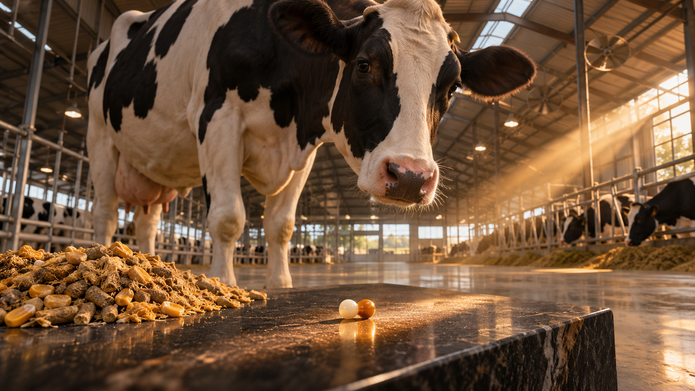
A dairy cow eats a lot of protein and turns surprisingly little of its nitrogen into milk.
Depending on the animal, somewhere between about 14% and 45% of the nitrogen in its feed ends up in milk protein. Much of the rest leaves the farm through urine and manure.
That difference matters to dairy farmers, who pay for feed protein, and to the environment, where excess nitrogen contributes to pollution.
A study published in Nature Communications on November 6, 2026, points to an unexpectedly small player in that equation: a dipeptide, a molecule made of just two amino acids joined together, associated with the microbes living in a cow’s rumen.
Researchers studying 30 dairy cows found that animals with more proline-containing dipeptides in their rumens, particularly one called glycine-proline, tended to convert feed nitrogen into milk more efficiently.
The team also identified a microbial enzyme capable of releasing these small peptides and demonstrated its activity in laboratory experiments.
The study does not prove that adding the peptide to feed improves milk production or reduces nitrogen waste. But it identifies a possible mechanism that scientists can now test.
It is an offbeat result, and an observational one, but it says something interesting about how peptides move through a living gut.
Why a Dairy Cow’s Nitrogen Budget Matters
The researchers, led by Wenlingli Qi and colleagues at Zhejiang University’s Institute of Dairy Science, frame the problem in environmental terms.
Livestock production loses substantial quantities of nitrogen to the environment. The paper cites estimates suggesting that nitrogen losses from livestock systems represent roughly one-third of global human-caused nitrogen emissions, with ruminant supply chains responsible for a major share.
Nitrogen utilisation efficiency, abbreviated NUE, is a straightforward measure: the amount of nitrogen recovered in milk divided by the amount of nitrogen the cow consumes.
Improve that ratio, and more dietary nitrogen becomes a useful agricultural product rather than potential waste.
The rumen, the large fermentation chamber at the beginning of a cow’s digestive system, plays a major role in determining what happens to that nitrogen.
The paper notes that approximately 60% to 80% of dietary protein is degraded in the rumen into smaller peptides and amino acids.
Microbes can use these nitrogen-containing compounds to build their own proteins. That microbial biomass can subsequently supply nutrients to the animal as it moves through the digestive tract.
But the system also has a substantial leakage problem.
When microbial protein breakdown and amino acid degradation produce ammonia faster than microbes can incorporate the available nitrogen, excess ammonia can be absorbed, processed into urea and eventually excreted.
That represents nitrogen the cow consumed but did not recover in milk.
Small peptides sit near this metabolic fork in the road. Their nitrogen can potentially be captured for microbial growth or released through further degradation.
The researchers wanted to know whether particular small peptides, and the microbial enzymes responsible for processing them, might help explain why some cows retain more dietary nitrogen than others.
Reading the Rumen’s Dipeptide Pool
The central animal study involved 30 mid-lactation Holstein dairy cows.
The researchers collected rumen fluid samples and examined their small-peptide composition using high-performance chemical isotope-labeling metabolomics, a technique that helps detect and compare metabolites present in biological samples.
They detected 349 small peptides.
Of these, 347 were classified as dipeptides, including reported isomeric forms. Dipeptides consist of two amino acids connected by a peptide bond.
Proline-containing dipeptides were the largest group, with 46 identified species.
Proline was also the only amino acid observed in combinations with every essential amino acid represented in the dataset.
The researchers then looked for groups of peptide signals that rose and fell together across different cows.
One network contained 19 dipeptides, including 15 that contained proline. This group was positively associated with nitrogen utilisation efficiency.
That association remained after adjusting for several factors that could influence the relationship, including milk production, feed intake, days in milk, body weight and parity.
Within the proline-rich group, glycine-proline, written Gly–Pro, showed the strongest positive association with NUE.
A separate statistical selection method also prioritized Gly–Pro as the leading NUE-associated dipeptide.
The strongest single peptide signal in the cow data came from a molecule containing just two amino acids: glycine and proline.
The team then compared the eight cows with the highest covariate-adjusted efficiency rankings against the eight with the lowest.
Average measured NUE was 29.78% in the high-efficiency group and 25.69% in the low-efficiency group, a difference of 4.09 percentage points.
Gly–Pro was among the most clearly differentiated peptide signals, with higher relative abundance in the more efficient animals.
That comparison is important, but it must be interpreted correctly.
The researchers selected groups according to existing differences in nitrogen efficiency. They did not give one group Gly–Pro and demonstrate that the compound caused an improvement.
The result establishes an association worth investigating, not a feeding strategy ready for dairy farms.
The Microbial Enzyme Behind the Dipeptide
The researchers also had metagenomic data from the same 30 cows. That allowed them to examine the microbial genes associated with differences in the rumen peptide pool.
One enzyme family kept appearing in the analysis.
The S15 family includes peptidyl-peptidases that can release dipeptides ending in proline from the beginning of longer peptide chains.
A particular subtype, S15.001, was positively associated with Gly–Pro abundance and the proline-rich peptide network.
It was also more abundant in cows classified as having higher nitrogen utilisation efficiency.
When the researchers added S15.001 to a statistical model already accounting for milk production, feed intake, days in milk, body weight and parity, the proportion of variation in NUE explained by the model rose from 79% to 83%.
That four-percentage-point increase strengthened the case for studying the enzyme. It does not demonstrate that S15.001 independently caused higher NUE or that the model would predict performance equally well in another herd.
There is a biochemical reason proline-containing peptides might behave differently.
Proline has an unusual ring-shaped chemical structure that constrains the geometry of nearby peptide bonds. That can make certain bonds less accessible to nonspecific peptide-degrading enzymes.
As a result, some proline-containing peptides may persist long enough to be transported or metabolized instead of immediately being broken down into individual amino acids.
That possibility gives Gly–Pro a plausible role in rumen nitrogen metabolism.
It also illustrates a familiar idea from peptide drug development: the arrangement of amino acids can strongly influence how a peptide interacts with degrading enzymes.
Grey Pepper previously examined this principle in how semaglutide was engineered to remain active in the body for approximately a week.
In dairy cattle, the biochemical question is different. Researchers are interested in whether peptide processing helps nitrogen remain available for microbial metabolism instead of being converted into ammonia and lost.
What the Laboratory Experiments Confirmed, and What They Didn’t
The researchers did not stop at statistical associations.
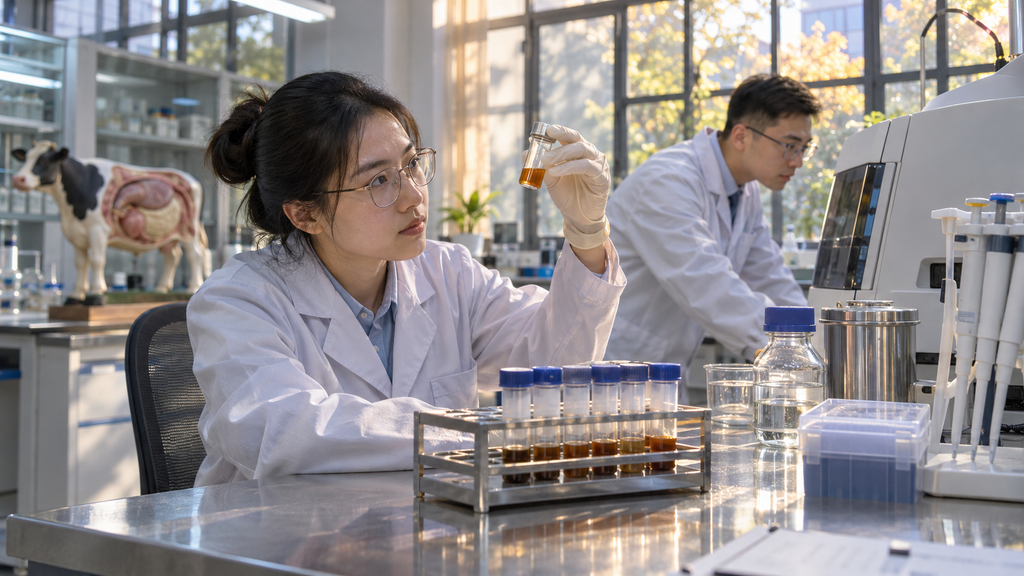
They conducted short-term incubations using rumen fluid and a laboratory substrate called Gly–Pro-pNA, which can be used to investigate peptide-cleaving activity.
Under the experimental conditions, the substrate increased the release of a measurable marker compound, p-nitroaniline, and increased the abundance of Gly–Pro.
An enzyme inhibitor reduced substrate cleavage, while a condition designed to limit downstream Gly–Pro breakdown allowed more of the dipeptide to accumulate.
These experiments supported the idea that rumen microbial enzymes could release Gly–Pro from longer peptide substrates.
The team then examined microbial gene activity under Gly–Pro-enriched laboratory conditions.
They observed higher expression of genes associated with peptide transport, nitrogen assimilation and amino acid biosynthesis.
At the same time, genes associated with amino acid breakdown and deamination showed lower expression.
Those patterns are consistent with a microbial community directing more nitrogen toward assimilation and biosynthesis rather than breaking amino acids down into ammonia.
But gene expression is not the same as directly measuring nitrogen incorporation into microbial protein.
The researchers also identified a rumen bacterium carrying S15.001, investigated the enzyme in bacterial culture and produced it in a laboratory expression system.
The experimental enzyme cleaved Xaa–Pro peptide substrates, confirming the activity predicted from its classification.
That is an important piece of mechanistic evidence. The researchers demonstrated that the enzyme can perform the relevant chemical reaction, rather than relying only on gene annotations.
Still, there are limits.
The cow metabolomics data measured relative peptide signals, not absolute concentrations.
Urinary nitrogen output and nitrogen retention were estimated rather than determined through complete direct collection.
The laboratory incubations were short-term systems that did not reproduce continuous feeding, absorption and the full interactions between an animal and its microbial community.
The researchers also observed lower expression of certain methane-related microbial genes under their experimental conditions.
That is not evidence that the cows produced less methane. Actual methane emissions were not measured.
The researchers confirmed a microbial enzyme’s ability to release proline-containing dipeptides. They did not prove that feeding those peptides would make cows more efficient.
The authors explicitly acknowledge that the modest animal cohort limits causal inference.
They recommend additional experiments, including isotope tracing, work with native peptide substrates and controlled feeding or microbial interventions in living animals.
Those studies would help determine whether nitrogen from Gly–Pro is actually incorporated into microbial protein or other nutrient pools available to the cow.
Until then, the pathway remains a promising mechanistic hypothesis rather than a proven method for improving dairy production.
Why a Dairy Cow Study Belongs in a Peptide Newsletter
Strip away the farm, and this is a study about how a microbial community decides the fate of small peptides.
That question has relevance far beyond dairy nutrition.
Across biological systems, peptide metabolism determines how proteins are broken down, how amino acids become available and how small molecules move through microbial and host metabolic networks.
Not every important peptide is a hormone, and not every peptide-related discovery points toward a pharmaceutical drug.
Some peptides act as metabolic intermediates. Others are substrates for specialized enzymes. Their biological significance can depend on which microbes are present, which enzymes they express and what happens to the molecules after they are released.
We saw a related theme in the research discussed in Grey Pepper’s article on metformin, Lac-Phe and a gut transporter, where the movement and processing of a small metabolite contributed to a proposed metabolic mechanism.
The comparison is conceptual, not clinical. The dairy-cow study contains no human experiments and provides no evidence that people should consume Gly–Pro or proline supplements.
For animal nutrition, however, the next question is practical.
Could dietary formulation, microbial community management or targeted enzyme activity eventually shift rumen nitrogen metabolism toward more useful protein synthesis?
The current study offers candidates to investigate: a specific class of proline-containing dipeptides, Gly–Pro in particular, and a microbial enzyme subtype called S15.001.
If controlled experiments confirm that manipulating this system improves nitrogen utilisation efficiency, researchers may have a new route toward reducing feed nitrogen losses without simply changing the quantity of protein supplied.
If the intervention studies fail, the work will still have contributed a detailed map of hundreds of small peptides in the rumen and identified microbial activities that had previously been poorly characterized.
That is a useful scientific result in its own right.
The most interesting part of this research is not a promise of more milk. It is the possibility that small differences in microbial peptide processing help explain why animals consuming nitrogen can end up using it differently.
Some of the most consequential peptides in a living system may be only two amino acids long. What matters is not just their size, but what the microbes do with them.
Sources and Further Reading
- Qi W, Chen X, Guo H, et al. Microbiome-derived proline dipeptides underpin improved nitrogen utilization efficiency in dairy cattle. Nature Communications, 17, Article 11495. Published November 6, 2026. DOI: 10.1038/s41467-026-78994-9.
- PubMed. Microbiome-derived proline dipeptides underpin improved nitrogen utilization efficiency in dairy cattle. PMID: 42995195.
- PubMed Central. Full-text research publication and supporting discussion of rumen peptide metabolism, microbial enzymes and study limitations. PMCID: PMC13743748.
- Grey Pepper. How Semaglutide’s Half-Life Was Extended Through Peptide Engineering.
- Grey Pepper. Metformin, Lac-Phe and the Gut Transporter Connection.