

Historical profile. In the spring of 1922, James Havens was 22 years old, the son of an Eastman Kodak executive in Rochester, New York, and, by the University of Toronto’s insulin archive, too weak to sit up in bed. He weighed less than 74 pounds. His doctor, John Ralston Williams, travelled to Toronto to ask for a chance to try the new pancreatic extract on him. In May, James Havens became the first person in the United States to receive insulin. His early treatment was difficult, but he survived, lived nearly four more decades and became a nationally recognized artist.
His case sits at an underappreciated junction in medical history: the moment insulin crossed the border, and the same weeks in which Eli Lilly and Company secured an agreement with Toronto that would help turn an experimental treatment into a commercial medicine. A century later, Lilly’s biggest products, Mounjaro and Zepbound, are injectable drugs built around engineered gut-hormone activity. The road to modern peptide medicine ran, in part, through a sickroom in Rochester.
A Kodak Executive’s Son With No Options Left
Havens was born in 1900. His father, James S. Havens, was a vice president at Eastman Kodak, according to the University of Rochester Medical Center’s archive of Williams’s papers. The younger Havens was diagnosed with diabetes as a teenager. A rigid diet partly controlled his disease for several years, but, as with other children and young adults with type 1 diabetes before insulin, dieting could only delay the consequences of a body unable to produce enough of the hormone.
By the spring of 1922 he was near death. The University of Toronto’s historical exhibit describes him as weighing less than 74 pounds and being “too weak to sit up in bed.” Rochester’s archive adds that his daily food intake had fallen to about 800 calories, even as his blood sugar remained high.
Toronto’s discovery had only just become public. Leonard Thompson, a 14-year-old patient at Toronto General Hospital, had received his first pancreatic extract injection on January 11, 1922, followed by a more effective purified preparation on January 23. The experimental treatment offered hope that severe diabetes might no longer be an inevitable death sentence.
Williams was an internist who had established a laboratory devoted to metabolic disorders in Rochester in 1916. After learning about Banting’s work, he travelled to Toronto to seek access for Havens. The University of Rochester’s archival account places that meeting in April 1922; a University of Toronto exhibit describes a personal appeal to J.J.R. Macleod in mid-May.
What matters is the outcome. Williams obtained an agreement that insulin would be sent to Rochester when a supply became available.
Havens was too weak to sit up. The experimental treatment that might save him was being produced in tiny, unreliable batches across an international border.
The Insulin Famine He Arrived In
The timing was terrible. Toronto barely had insulin for its own patients. After biochemist James Collip’s January breakthrough, production had moved to the Connaught Anti-Toxin Laboratories, where attempts to scale up the purification process repeatedly failed. The University of Toronto’s historical archive describes an insulin “famine” from approximately early March to mid-May 1922. At least one patient died after the supply ran out.
Even so, the Toronto team agreed to provide insulin for Havens. Macleod and Frederick Banting supported the attempt, and Williams administered the extract in Rochester.
The exact first-injection date is not consistently reported. The University of Toronto’s Insulin 100 exhibition gives May 21, 1922, while another of its historical summaries and the University of Rochester’s archival account give May 22. Both institutions identify Havens as the first person treated with insulin in the United States.
The first injections did not produce the improvement everyone hoped for. Banting travelled to Rochester on May 26 to examine Havens and help adjust treatment. As the dose and supply improved, Havens began to recover. Within approximately two weeks he was strong enough to get out of bed and walk around the house.
But the road was not smooth. In a July 11 letter to Banting preserved by the University of Toronto, Williams described painful injections, interruptions to treatment and a frightening reaction to one preparation. The letter begins with a plain admission: “We have had a lot of trouble with Jim Havens.”
Early insulin was not the reliable medicine it would later become. It was an extract whose potency, purity and supply could vary. Doctors were still learning how to use it, and patients were absorbing the uncertainty in their bodies.
Havens’s own correspondence gives a more personal account of what survival meant. In a letter to Banting dated August 12, 1922, he celebrated being able to eat egg on toast again, a simple meal that had become extraordinary after years of restrictions.
Toronto had discovered a treatment. Getting enough of it, and making every batch dependable, was another problem entirely.
Lilly Enters the Story
In those same weeks, the business of insulin was being decided. George Clowes, Eli Lilly’s research director, had repeatedly pressed Toronto to collaborate. The university needed help producing the extract in larger quantities, and Lilly had the industrial resources to attempt it.
At the end of May 1922, Toronto and Lilly agreed to pool their knowledge. In return, Lilly received an exclusive head start in the large U.S. market. Connaught would handle Canadian production, while other manufacturers would receive licences later. The university retained control through its patent and licensing arrangements.
Lilly invested heavily in production, eventually improving the consistency and potency of the extract. By early July, it was shipping potent insulin to Toronto, gradually easing the shortage. Leading American diabetes physicians began treating selected patients with Lilly insulin later that summer.
Williams was part of the broader commercial transition. The University of Rochester’s archive records that he became a consultant to Lilly and was selected to test its insulin preparation in diabetic patients. His papers preserve correspondence with Banting and Lilly Research Laboratories, as well as early studies of insulin treatment published in 1922 and 1923.
It is important not to merge two events into one. Havens initially received insulin supplied from Toronto’s Connaught laboratories, before Lilly’s later production improvements. The sources reviewed for this article do not establish exactly when he changed preparations. His early survival should not be attributed to a Lilly product without that evidence.
But the overlap in timing reveals the central difficulty of the discovery. Saving one desperately ill patient required doctors to secure scarce experimental material. Saving thousands required a production system capable of delivering a dependable drug.
Havens lived through the transition. By April 1923, Williams could describe him in a surviving letter to Banting as “the picture of health.”
From Patient to Printmaker
The more remarkable part of Havens’s life came after. His recovery gave him the opportunity to resume his education and develop the artistic abilities that would define his adult career.
The University of Rochester Medical Center records that he earned an art degree from the Rochester Athenaeum and Mechanics Institute, the predecessor of the Rochester Institute of Technology. Other art-historical accounts describe his studies at the University of Rochester and his printmaking instruction under Troy Kinney and at the Woodbury School in Ogunquit, Maine.
He became known for color woodblock prints depicting natural landscapes, plants, birds and rural scenes. The process required an artist to translate a drawing into carved wooden surfaces, ink the blocks and print an image on paper. Different colors could require separately prepared printing surfaces and careful alignment.
Havens belonged to the American color woodblock revival and helped establish the Print Club of Rochester. The club identifies him as one of its founding members, and he designed its logo.
His artistic career left a substantial public record. The Memorial Art Gallery of the University of Rochester mounted a centennial exhibition in December 2000 featuring approximately 40 Havens woodblock prints, with works from its own collection and loans from the Strong Museum. His prints are also represented in the collections of the Library of Congress and the Metropolitan Museum of Art, according to Rochester’s medical archive.
His documented works include a 1946 color woodcut originally titled Garden Corner, later renamed Rabbit Fence. The title, date and medium are recorded by Meibohm Fine Arts. His landscapes are more than an incidental detail in a medical biography. They are the work of an artist who had been expected to die in his early twenties.
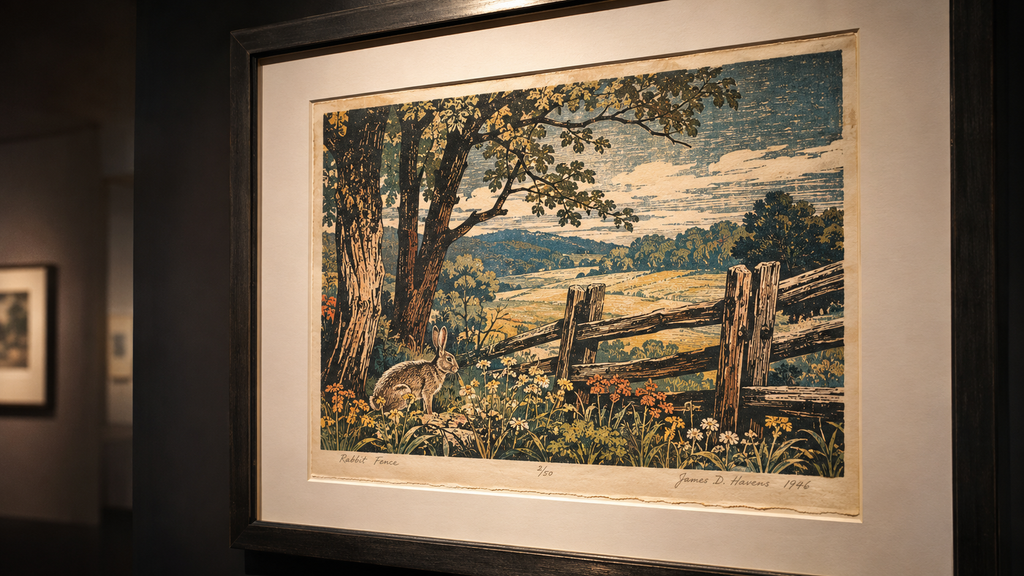
Havens married and had two children. He continued living and working in the Rochester area, and died of cancer in 1960, at the age of 60. He had lived almost four decades longer than seemed possible when Williams approached the Toronto researchers.
Insulin did not simply keep James Havens alive. It gave him the years in which to become the artist whose work survives him.
What James Havens’s Case Tells Us About Peptide Medicine
Havens’s story is usually summarized in a sentence: America’s first insulin patient became an artist. Read alongside the manufacturing and archival record, it reveals three problems that still define medicine built around biological molecules and peptides.
The first is access. Havens received a scarce experimental treatment because his physician travelled to Toronto and successfully advocated for him. His father’s position at Kodak also gave the family resources and connections unavailable to many other patients. The archives do not establish that wealth alone determined the decision, but the unequal ability to reach experimental treatment is difficult to ignore.
Across the Atlantic, another personal connection helped bring insulin production to Denmark. Grey Pepper covered that history in its account of August and Marie Krogh and the origins of Novo Nordisk. Early insulin was not distributed through the broad health systems that later became familiar. It travelled through laboratories, letters, individual doctors and a small number of influential institutions.
The second problem is manufacturing. The Toronto team could demonstrate that an extract worked before it could reliably produce enough for its patients. Lilly’s role was not to discover insulin, but to help solve the different problem of producing it at useful scale. Those are separate scientific and industrial achievements.
The third is what happens when medicine becomes a commercial product. Toronto’s licensing decisions, Lilly’s early U.S. advantage and the eventual expansion of insulin manufacturing all helped determine how widely the treatment could reach people. Those arrangements shaped the first mass-market peptide hormone medicine.
The comparison with modern GLP-1 drugs is not exact. Their chemistry, clinical uses, manufacturing methods and regulatory systems are very different. But shortages, treatment access and the ability to manufacture complex medicines at scale remain familiar themes.
Havens’s case also has limits as historical evidence. He was an unusually well-connected patient, and his treatment was closely monitored. It would be wrong to treat his recovery as representative of what every American with diabetes experienced in 1922. The initial supplies were scarce, injections could be painful, and the early preparations were not always reliable.
What the surviving record does show is enough: a young man too weak to sit up in May 1922, walking again after weeks of treatment, and eventually developing a respected career in printmaking.
Today’s arguments over insulin prices, GLP-1 shortages and who gets a new medicine first can feel uniquely modern. Havens’s experience shows how early those tensions appeared. Access to scientific discovery, industrial capacity and medical advocacy intersected in a single patient’s life.
He left behind more than a case history. He left prints, drawings and a body of work that would not have existed without insulin. That may be the clearest measure of what the treatment made possible.
Sources
- University of Toronto Libraries, Insulin 100 — James D. Havens. Primary historical exhibition incorporating correspondence from Williams and Havens, accessed November 2026.
- University of Toronto Libraries — VII. Resurrections in Toronto. Insulin supply shortages and the early agreement with Eli Lilly, accessed November 2026.
- University of Toronto Libraries — From a Patient’s Point of View. Early insulin patients, treatment dates and clinical outcomes, accessed November 2026.
- University of Rochester Medical Center, Edward G. Miner Library — John Ralston Williams Collection. Biographical information and historical archival finding aid, accessed November 2026.
- University of Rochester Medical Center, Edward G. Miner Library — John Ralston Williams: Rochester’s Insulin Pioneer, July 9, 2025. Archival account of Havens’s treatment and subsequent artistic career.
- Memorial Art Gallery of the University of Rochester, via Traditional Fine Arts Organization — Woodblock Prints by James Havens: A Centennial Celebration, 2000. Exhibition and artist biography.
- Meibohm Fine Arts — James D. Havens Artist Catalogue. Artwork titles, dates and printmaking media, accessed November 2026.