
By Grey Pepper Editorial
Historical profile. The jararaca is a pit viper of southeastern Brazil, and for most of the twentieth century its bite was a medical emergency rather than a lead for drug development.
Yet its venom contained small peptides that would help inspire an entire class of blood pressure medicines.
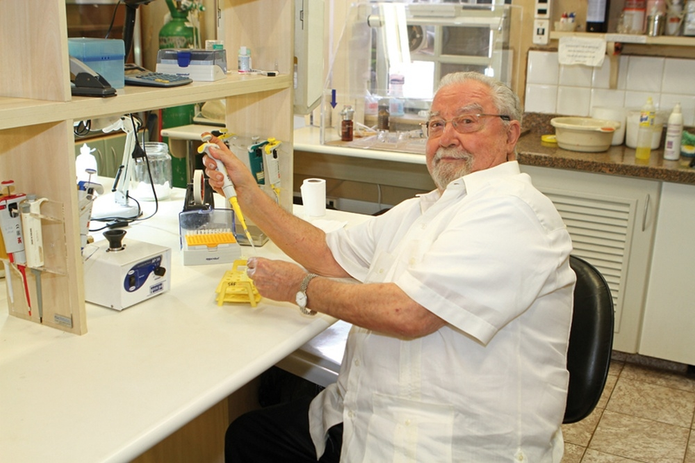
The scientist who first described their unusual activity was Sérgio Henrique Ferreira, a Brazilian pharmacologist who published his discovery of a venom-derived bradykinin-potentiating factor in 1965.
His work helped set in motion a chain of discoveries that led to captopril, the first orally active angiotensin-converting enzyme inhibitor introduced into clinical practice.
The story runs from Brazilian physiology laboratories through London pharmacology and into American pharmaceutical chemistry. It also raises a question about scientific credit: why is the person at the beginning of that chain so rarely named at the end?
Ferreira was born in Franca, São Paulo state, in 1934 and trained in medicine at the University of São Paulo. He completed doctoral research under pharmacologist Maurício Rocha e Silva at the Ribeirão Preto School of Medicine.
That apprenticeship mattered because Rocha e Silva’s laboratory had already uncovered one of the most important biological effects of jararaca venom.
What Bradykinin Is, and Why Venom Made It Visible
In 1948, Rocha e Silva and colleagues Wilson Teixeira Beraldo and Gastão Rosenfeld identified bradykinin while studying blood plasma exposed to snake venom. Their findings were published in the American Journal of Physiology in February 1949.
Bradykinin is a nine-amino-acid peptide that can relax blood vessels and lower blood pressure. The venom triggered the release of this peptide from proteins in blood plasma, helping researchers understand part of the dramatic circulatory response associated with envenomation.
But bradykinin has a problem: it does not last long.
Enzymes rapidly break it down. One of those enzymes is angiotensin-converting enzyme, or ACE, which later became a major target for blood pressure medicines.
ACE performs two important functions. It contributes to the breakdown of bradykinin, removing a blood-vessel-relaxing signal, and converts angiotensin I into angiotensin II, a peptide that constricts blood vessels and raises blood pressure.
That creates an attractive pharmacological target: inhibit ACE, and the body can preserve more bradykinin while producing less angiotensin II.
The relationship was not yet fully established when Ferreira began studying the venom. His experiments would supply an important part of the evidence.
The venom held peptides that made bradykinin last longer. That was the first clue.
Ferreira’s 1965 Bradykinin-Potentiating Factor
Ferreira’s contribution was to show that jararaca venom did more than trigger bradykinin production. It also contained substances that amplified and prolonged bradykinin’s physiological effects.
His landmark paper, A Bradykinin-Potentiating Factor (BPF) Present in the Venom of Bothrops jararaca, appeared in the British Journal of Pharmacology and Chemotherapy in February 1965.
What Ferreira described as bradykinin-potentiating factor was not a single molecule. It was a mixture containing short peptides, later separated and investigated individually.
The distinction matters. The original discovery identified a biological activity in the venom. Subsequent experiments helped determine which peptides produced that activity and how they interacted with the enzymes controlling blood pressure.
Ferreira’s scientific approach depended on bioassays: experiments that measure how living tissues respond to a substance. These methods could reveal biological activity even when the complete molecular explanation remained unknown.
According to an obituary published by Revista Pesquisa FAPESP, Ferreira initially included his adviser Rocha e Silva as a coauthor on the discovery paper.
Rocha e Silva reportedly removed his own name, telling the younger scientist: “If I go in on it, no one will believe that you did it yourself.”
Ferreira’s 1965 paper ultimately appeared under his name alone.
It was a revealing moment of scientific recognition. A senior researcher allowed his student to take public responsibility for a discovery that would become far more consequential than either could demonstrate at the time.

London, ACE, and the Leap From a Venom Peptide to Captopril
Ferreira went to England in the mid-1960s to work with John Vane at the Royal College of Surgeons in London. Vane would later share the 1982 Nobel Prize in Physiology or Medicine.
A 2023 historical editorial in Toxins, written by Y. S. Bakhle and B. R. Ferreira, describes how Ferreira’s plans for an Oxford fellowship changed and brought him into Vane’s group instead.
The London laboratory was developing techniques for studying how biological substances changed as blood moved through the circulation. Ferreira brought both his expertise in bradykinin and a sample of his venom-derived factor.
Using Vane’s blood-bathed organ technique, Ferreira demonstrated that bradykinin was extensively inactivated as it passed through the lungs. His bradykinin-potentiating factor could inhibit that process.
Meanwhile, Kevin Ng and Vane were investigating the conversion of angiotensin I into angiotensin II in the pulmonary circulation.
The critical connection emerged when Bakhle found that Ferreira’s venom factor could also inhibit ACE activity in lung preparations. That helped connect the destruction of bradykinin with the production of angiotensin II.
Further work brought Ferreira together with Lewis Greene and other collaborators to isolate and characterize individual peptides. A 1970 paper in Nature, coauthored by Ferreira, Greene, V. A. Alabaster, Bakhle and Vane, documented inhibition of angiotensin-converting enzyme by fractions of the venom factor.
This was the bridge from a snake venom observation to a drug target.
One particularly promising peptide was teprotide, a nine-amino-acid ACE inhibitor derived from the venom research. It demonstrated that the target could be inhibited and that doing so could reduce blood pressure.
But teprotide had disadvantages. It required injection and was not a convenient candidate for routine oral treatment.
Researchers at Squibb, including Miguel Ondetti, Bernard Rubin and David Cushman, pursued another approach: design a smaller, orally active molecule capable of inhibiting the same enzyme.
Using knowledge of ACE inhibition, peptide structure and enzyme-binding chemistry, they developed synthetic compounds based around proline-containing structures.
Succinyl-L-proline supplied an early lead. Replacing a carboxyl group with a sulfhydryl group produced a much more potent inhibitor, and further adjustments led to captopril.
Ondetti, Rubin and Cushman described the new orally active inhibitors in Science in April 1977. The US Food and Drug Administration approved captopril on April 6, 1981.
A peptide that could not be swallowed helped inspire a small molecule that could.
Credit, Geography, and the Peptide Lesson
Captopril was not itself a peptide drug extracted from snake venom. It was a synthetic small molecule designed using knowledge gained from studying venom-derived peptides and the enzyme they inhibited.
That distinction is central to the history.
Ferreira’s peptides helped validate ACE as a pharmacological target. The Squibb chemists then designed molecules with properties better suited to oral administration.
The same tension between biological potency and convenient delivery continues to influence drug development today, as Grey Pepper has explored in its coverage of modern peptide drug platforms.
Captopril’s clinical success also opened the way for additional ACE inhibitors, including enalapril, lisinopril and ramipril. Different chemical structures and pharmacological properties offered additional options, although adverse effects such as cough remain relevant across the ACE inhibitor class.
The discovery chain crossed continents. The original peptide biology came from Brazil, the enzyme studies were extended in London, and the final oral drug emerged from pharmaceutical chemistry in the United States.
That international collaboration makes the history richer, but it also complicates the allocation of credit.
A 2016 Agência FAPESP report quoted Brazilian scientist Eduardo Moacyr Krieger as saying Ferreira had received no commercial proceeds from his discovery, while remaining proud of research that helped millions of patients. That is a colleague’s retrospective account, not a complete financial or patent history.
What the published scientific record demonstrates is that Ferreira’s original work was an essential early step, even though later chemistry and clinical development were necessary to produce captopril.
After Captopril: Pain, Aspirin, and Science Policy
Ferreira’s career did not end with the blood pressure research.
During another period in London in the early 1970s, he joined research into prostaglandins and the mechanism of action of aspirin.
That work was closely connected to Vane’s demonstration that aspirin and other nonsteroidal anti-inflammatory drugs inhibit prostaglandin synthesis.
Ferreira helped clarify how prostaglandins contribute to pain sensitization, and he continued investigating inflammation and analgesia after returning to Brazil.
He also explored the peripheral effects of opioid drugs, challenging the idea that morphine’s analgesic activity had to be explained entirely through the central nervous system.
Later work included a phenomenon he called teleantagonism, involving experimental interactions between drugs acting at peripheral and central sites along pain pathways.
Ferreira also became an influential voice in Brazilian science policy. He served two terms as president of the Brazilian Society for the Advancement of Science between 1995 and 1999, advocating for scientific institutions and long-term national research priorities.
Like the researchers profiled in Grey Pepper’s story about John Hughes and the body’s own opioid peptides, Ferreira approached small biological molecules as signals capable of revealing much larger physiological systems.
Why Sérgio Ferreira’s Name Still Matters
Ferreira died on July 17, 2016, at age 81. By then, ACE inhibitors had become established medicines for hypertension and several other cardiovascular and kidney conditions.
His historical importance does not rest on the claim that he invented captopril. He did not.
His achievement was helping expose the biology that made the drug possible. He identified an unusual activity in snake venom and pursued it with enough precision that other scientists could connect it to an enzyme, a mechanism and eventually a treatment.
The result was a collaboration spanning Brazilian physiology, British pharmacology and American drug chemistry.
There is a broader lesson in that chain. Nature does not hand scientists finished medicines. It provides molecules, activities and unexpected observations. Turning those into useful treatments requires experiments, interpretation and often years of chemical engineering.
The jararaca’s venom was a complex biological weapon. Ferreira saw in it a way to understand how the body regulates its blood pressure.
Others developed the medicine. But the discovery that made the story possible came from a young pharmacologist in Ribeirão Preto who looked at venom and found a mechanism.
Sources and Further Reading
- Rocha e Silva M, Beraldo WT, Rosenfeld G. Bradykinin, a hypotensive and smooth muscle stimulating factor released from plasma globulin by snake venoms and by trypsin. American Journal of Physiology, 1949.
- Ferreira SH. A Bradykinin-Potentiating Factor (BPF) Present in the Venom of Bothrops jararaca. British Journal of Pharmacology and Chemotherapy, February 1965.
- Ferreira SH, Greene LJ, Alabaster VA, Bakhle YS, Vane JR. Activity of Various Fractions of Bradykinin Potentiating Factor against Angiotensin I Converting Enzyme. Nature, 1970.
- Ondetti MA, Rubin B, Cushman DW. Design of Specific Inhibitors of Angiotensin-Converting Enzyme: New Class of Orally Active Antihypertensive Agents. Science, April 1977.
- Bakhle YS, Ferreira BR. Sérgio Ferreira and Bothrops jararaca at the Royal College of Surgeons, London. Toxins, August 25, 2023.
- Fioravanti C. Innovative Vision of Pharmacology. Revista Pesquisa FAPESP, August 2016.
- Agência FAPESP. Sérgio Henrique Ferreira é homenageado na abertura da FeSBE. September 1, 2016.
- University of Bristol School of Chemistry. Captopril — Molecule of the Month, August 2012.
- Profile of Sérgio Ferreira. Proceedings of the National Academy of Sciences, 2008.