

On November 9, 2026, the maximum retail price of Palbopro, a breast cancer medicine containing palbociclib and manufactured by RPG Life Sciences, fell from ₹40,421.33 to ₹2,720 in India.
Abirone, an abiraterone brand from Arvincare Pharma used in prostate cancer treatment, went from ₹41,250 to ₹3,218.23.
Those figures are not estimates. They appear in an official price table published by India’s Ministry of Chemicals and Fertilizers on November 7.
The reductions did not follow the invention of a cheaper molecule or a change in the medicines themselves. India’s drug price regulator had imposed a limit on the trade margins built into their maximum retail prices.
Across the affected medicines, the largest reported reduction reached 96.45%.
That mechanism, known in India as trade margin rationalisation, is the reason this story matters beyond India. It shows how heavily a medicine’s printed retail ceiling can be influenced by the margins between the manufacturer, distributors, retailers and hospitals.
It also raises an uncomfortable question: when a drug’s listed price can fall by more than 90% without changing the drug, what was the old price actually measuring?
What India’s Regulator Changed
The National Pharmaceutical Pricing Authority, or NPPA, operates under India’s Department of Pharmaceuticals in the Ministry of Chemicals and Fertilizers.
On October 17, 2026, the authority introduced trade margin rationalisation covering 137 identified non-scheduled anti-cancer medicines.
The decision followed recommendations from an expert committee constituted under the Directorate General of Health Services. Its legal basis was Paragraph 19 of India’s Drugs (Prices Control) Order, 2013, which allows special pricing interventions in the public interest.
The operative notification was S.O. 5690(E), dated October 17. Revised maximum retail prices became effective nationwide on November 9.
The measure caps trade margins at 30% of the maximum retail price, excluding goods and services tax. Manufacturers must calculate revised price ceilings using specified distributor prices from March 2026.
This distinction matters. The order does not require every medicine to become exactly 30% cheaper. Instead, it restricts how much margin can be incorporated into the maximum retail price relative to the relevant distributor price.
When an earlier retail ceiling contained a very large margin, the resulting reduction could be substantial.
The intervention also includes conditions intended to prevent manufacturers from offsetting the new limits through higher prices or reductions in supply. Manufacturers remain subject to the maximum permissible trade margin when seeking annual price adjustments under Paragraph 20(1) of the pricing order.
The policy builds on a 2019 Indian intervention that applied a similar 30% trade margin cap to 42 anti-cancer medicines.
The regulator did not change the cancer medicines. It changed how much margin could be built into their listed prices.
How Big the Cancer Drug Price Cuts Are
The reported figures changed as pharmaceutical companies submitted revised prices.
In its November 7 statement, the government said 76 manufacturers had reported revised maximum retail prices for 1,225 formulations covering 121 medicines.
Of those formulations, 1,031 showed price reductions, while 600 brands reported decreases exceeding 50%.
The highest reported reduction was 96.45%.
By November 8, figures reported by the Press Trust of India had risen to 85 pharmaceutical companies, 1,364 formulations and 679 brands with price reductions greater than 50%.
An updated government backgrounder published figures for November 9 showing approximately ₹3,541 crore in projected annual savings.
Those are government projections rather than measured savings from actual patient transactions. The estimate applies the difference between the old and revised prices to historical medicine sales volumes.
The two named brand examples illustrate how dramatic the changes can be.
Palbopro, a palbociclib 125 mg capsule brand, had its listed maximum retail price reduced by approximately 93.3%.
Abirone, an abiraterone acetate 250 mg tablet brand, saw a reduction of approximately 92.2%.
Both examples appear in the government’s brand-level price table. The table identifies the formulations but does not specify pack quantities, so the figures should be treated as the published brand prices rather than standardized per-tablet comparisons.
Neither example should be generalized to all 137 identified medicines. Some products experienced smaller price changes, and approximately 10 to 15 of the identified drugs had not yet been launched in India.
The trade margin rules will apply to those medicines when they enter the Indian market.
Why a Markup Cap Works on Cancer Medicines
In India, the maximum retail price printed on a medicine pack is the ceiling that a retailer or hospital pharmacy may charge for that product.
That price is not the same as the amount the manufacturer receives.
Between the manufacturer’s sale and the final patient transaction, medicines may pass through stockists, distributors, wholesalers, retailers and institutional pharmacies.
The trade margin reflects the difference between the relevant upstream price and the retail ceiling. When that gap is large, the printed maximum retail price can be substantially higher than the distributor price.
Those margins can support distribution expenses, discounts, retail operations and commercial incentives. They may also allow some sellers to offer apparently large discounts while still earning money on the transaction.
India’s intervention limits how much of that spread can remain in the revised retail price.
But there is an important qualification. A 90% reduction in maximum retail price does not prove that 90% of the old price represented pure profit. Nor does it reveal the medicine’s manufacturing cost or the amount patients typically paid after discounts.
What the intervention demonstrates is that some previously published price ceilings were far above the new limits calculated under the government’s margin rules.
The same distinction matters in the United States, where policymakers have increasingly questioned the relationship between pharmaceutical list prices and the amounts ultimately received or paid across the distribution system.
Grey Pepper previously examined that issue through pharmacy benefit manager fee disclosure requirements.
India’s retail margin cap is not equivalent to a U.S. pharmacy benefit manager rebate, but both debates concern the financial arrangements that separate the public price of a medicine from what different participants in the supply chain actually receive.
A medicine’s printed price is not necessarily its manufacturing cost, its actual selling price or the amount that reaches the company producing it.
Enforcement Is the Real Test
A lower maximum retail price only helps patients if pharmacies, hospitals and distributors comply with the new limits.
India’s Ministry of Chemicals and Fertilizers says retailers, dealers, hospitals and medical institutions must prominently display revised medicine price lists on their premises and websites.
State Drug Controllers are responsible for monitoring implementation, while the NPPA maintains updated lists of revised prices.
Consumers can consult the official NPPA website or the government’s Pharma Sahi Daam application to check applicable prices.
Complaints about overcharging can be submitted through official reporting channels, including the Pharma Jan Samadhan system or the NPPA helpline.
The government has also directed manufacturers not to reduce medicine production without the required permission and to provide notice before discontinuing affected products.
Those safeguards reflect another challenge associated with price controls: maintaining reliable access while restricting the revenues available within the distribution system.
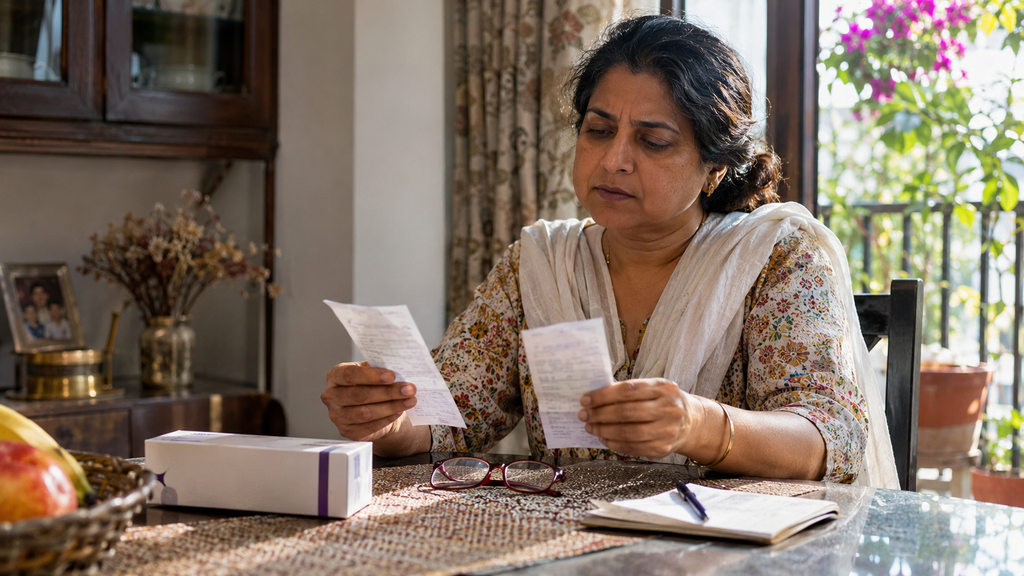
=== ADD ONE INLINE IMAGE HERE — UPLOADED IMAGE 4: INDIAN WOMAN SEATED AT HOME COMPARING TWO MEDICINE RECEIPTS BESIDE A WHITE MEDICATION CARTON. ILLUSTRATIVE PATIENT-COST SCENE REPRESENTING THE FINANCIAL PRESSURE OF MEDICINE PRICES. NOT AN ACTUAL PATIENT AFFECTED BY THE NOVEMBER 2026 NPPA ORDER. THE RECEIPTS AND MEDICINE CARTON ARE NOT AUTHENTIC EVIDENCE OF THE REPORTED PRICE CHANGES. ===
Whether the full expected savings reach patients remains an open question.
Some patients may previously have purchased medicines at substantial discounts below the printed maximum retail price. Their actual savings may therefore be smaller than the headline percentage reduction.
Other patients who previously paid prices close to the maximum could experience much larger reductions.
Distribution practices, availability, the use of alternative pack sizes and additional charges at hospitals are all relevant areas for future monitoring.
There is not yet evidence from the November intervention establishing whether hospitals will recover lost margins through other fees, whether shortages will emerge or whether treatment adherence will improve.
Those are potential consequences to investigate, not outcomes that have already been demonstrated.
What India’s Cancer Drug Prices Signal
For the global pharmaceutical industry, India’s decision illustrates a different approach to drug affordability.
Some governments focus on negotiating prices paid by public insurance programs. Others restrict reimbursement, encourage competition or control the prices at which medicines may be sold.
India’s latest intervention targets the distribution margin incorporated into the maximum retail price of certain non-scheduled cancer medicines.
That is different from the U.S. approach to Medicare drug price negotiation and inflation-related pricing rules, where the relevant mechanisms, payment systems and legal structures are not directly comparable.
The Indian policy uses an existing regulatory power, and its effects depend on how much margin was embedded in the previous retail ceiling.
It does not establish that all cancer medicines are overpriced by the same amount. It does not show that manufacturers can produce every affected medicine at a fraction of its former MRP. And it does not guarantee that every consumer will save the full difference between the old and new printed prices.
Those limitations do not make the intervention insignificant.
India’s government has documented substantial reductions in published retail ceilings for hundreds of cancer medicine brands, with estimated annual savings of approximately ₹3,541 crore if the historical sales volumes used in its calculation are sustained.
For individual patients, the practical significance will depend on actual pharmacy prices, continued supply, insurance arrangements and the total cost of treatment.
The more revealing lesson is about price formation.
When the listed price of a breast cancer medicine falls from ₹40,421 to ₹2,720 after a trade margin intervention, it becomes difficult to argue that the original price was simply an unavoidable reflection of the drug’s underlying production costs.
It was a retail ceiling shaped by the commercial arrangements between the manufacturer and the patient.
The lesson for everyone else is uncomfortable: sometimes the fastest way to reduce a medicine’s listed price is to examine who gets paid between the factory and the patient.
Sources and Further Reading
- Government of India, Ministry of Chemicals and Fertilizers. Trade Margin Rationalisation on 137 Anti-Cancer Drugs. October 17, 2026.
- Government of India, Ministry of Chemicals and Fertilizers. Revised Prices of Anti-Cancer Medicines to Come into Effect from November 9. November 7, 2026. Includes official brand-level price comparisons.
- Press Information Bureau. Cheaper Cancer Medicines: What the New Margin Cap Means for Patients. Official backgrounder containing updated November 9 figures.
- Press Trust of India via Business Standard. Cancer Drug Price Cuts Take Effect, Set to Save Consumers ₹3,540 Crore Yearly. November 9, 2026.
- National Pharmaceutical Pricing Authority. Revised Prices of 137 Anti-Cancer Drugs. Official price-list repository.


